13 November 2026 · 4 min read · The It’s an Invitation team
Wording an invitation to a memorial, funeral or celebration of life
Gentle, practical guidance for a hard task: what to include, phrases that work, what to leave out, and sample wordings for different traditions.
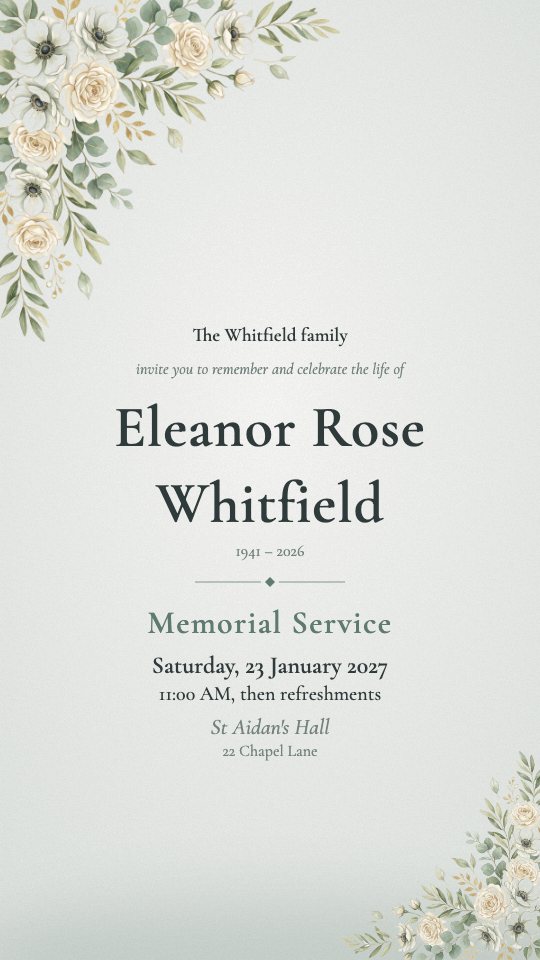
Nobody wants to write this invitation, and it usually has to be written quickly, by someone who is grieving. It does not need to be beautiful. It needs to be clear and kind, so that the people who loved someone know where to be and when.
Set the tone first
Let the person and the family decide the tone, not convention. Some gatherings are quiet and formal. Others are asked to be bright, with stories and favourite music.
Whichever it is, plain words serve best. Short sentences are easier to read through tears, and easier to write.
Choose the word for the gathering with care. A funeral usually means a service soon after the death. A memorial is often held later. A celebration of life signals a warmer, less formal occasion. "Prayers" or "remembrance" may fit your family better.
What to include
- The person's full name, and the name people knew them by.
- Who is inviting, usually "the family of…" or named relatives.
- What kind of gathering it is, and whether it is religious.
- Day, date and time.
- The place, with a full address. If there are two places, such as a service and then a reception, list both with times.
- Whether it is open to all who knew the person, or for family and close friends.
- Wishes about flowers or donations, if the family has any.
- A person to contact who is not the closest mourner.
- A way to say you are coming, if the family needs numbers for a meal.
Phrases that work
- "With great sadness, we share the news that…"
- "The family of … invite you to join them in remembering…"
- "Please join us to celebrate the life of…"
- "All who knew her are welcome."
- "In place of flowers, donations may be made to…"
If you are unsure whether to write "died" or "passed away", use the words the family uses when they speak.
What to leave out
- The cause of death, unless the family wishes to share it.
- Assumptions about belief. "She is in a better place" comforts some people and hurts others. Keep faith language to gatherings where the family shares it.
- Instructions about how to feel. "No tears" is kindly meant, but people will grieve as they grieve.
Sharing it privately
Send the invitation directly to the people who should have it, and say whether they may pass it on: "Please share with anyone who knew him" or "We are keeping this to family and close friends."
In It’s an Invitation, guest pages are not indexed by search engines and a page can be protected with a PIN, which suits a gathering the family would rather keep among those invited. If there is a private burial and a wider reception, the private part can be made invitation-only so it does not appear on the shared page.
Sample wordings
These are starting points. Change the words until they sound like your family.
A non-religious celebration of life
Please join us to celebrate the life of Margaret "Peggy" Lewis.
Saturday 16 January, 2 pm, at the Riverside Pavilion, Henley.
Come with a story to tell. Bright colours welcome.
Tea and cake afterwards. All who knew her are welcome.
A simple, formal memorial
The family of Dr Samuel Adeyemi invite you to a memorial service in his honour.
Thursday 28 January at 11 am, Fairfield Hall, Croydon.
A reception will follow. In place of flowers, the family ask for donations to the hospice that cared for him.
A gathering with prayers
With deep sorrow, we share that Abdul Rahman Siddiqui has returned to his Creator.
Prayers for him will be held on Sunday 17 January after the midday prayer at the community centre on Park Road.
A meal will be served afterwards. Please remember him in your prayers.
A remembrance some time later
One year on, we are gathering to remember Daniel Cohen.
Sunday 24 January, 3 pm, at his sister Ruth's home. Family and close friends.
Please let Ruth know if you can come.
Where the family uses two languages, the invitation can carry both side by side.
If you are writing this for someone else
Ask the family three questions: what should we call the gathering, who is it for, and is there anything you do not want said. Then write the shortest version that answers them, and let one family member read it before it goes anywhere.
People will come because of who it is for, not because of how it was worded.